spiegamelo.com

Session 22 24 November 2026 10 min

What It Was Like

Since then he’s asked me three times, and never in the same words. The first, on the phone: what was it like.

Listen on Apple Podcasts Spotify Amazon Music iHeart Podcast Index

Platethree times
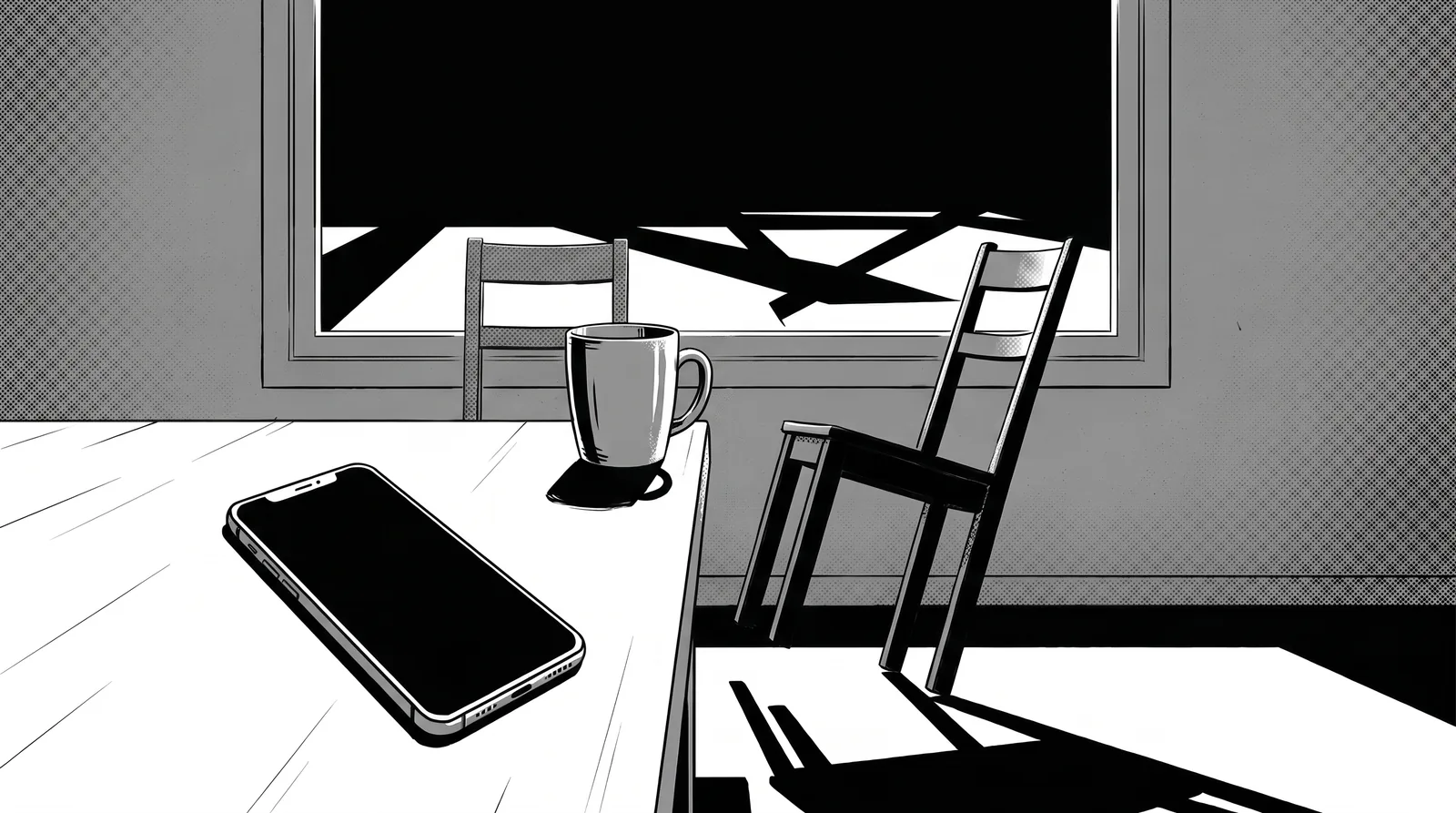
A pale table top fills the foreground, with a phone lying on it face up, its screen solid black, and a grey mug further back on a small dark mat. A plain dark chair stands side on at the right edge of the table, and a second, paler chair stands behind the table against the window. The window is a broad rectangle in a flat grey halftone wall: its upper part is solid black, and below that a hard white glare carries the long black shadows of a table and of chair legs. A band of white light lies across the dark floor on the right, with the near chair’s shadow laid over it. Nobody is in the picture, and nothing shows on the phone.

Story

A man has two days to write to his brother, whose birthday is on Thursday, and not a line put down. Their father died with him there for the last four days; his brother, who lives abroad, arrived the day after, and has asked three times since what those days were like, never in the same words. He answered three times, and the third stopped the asking. Three messages sit unanswered.

It was the worst thing that has ever happened to me and it was also very boring, and they’re the same four days, and I can’t get the two of them into one sentence.

Beside that the companion sets Thomas Nagel’s essay on what it is for a creature to have a point of view. He puts the mark of it in a phrase: ‘there is something that it is like to be that organism’, ‘something it is like for the organism’ (p. 436). His case is a bat, a mammal whose way of finding its way about in the dark is not like anything of ours (p. 438). Imagining oneself with wings, catching insects, hanging up to sleep, gives what it would be like to behave as a bat behaves, with the mind one has (pp. 438 to 439).

Nagel asks whether a point of view belongs only to the one who has it: ‘Rather it is a type.’ (p. 441) A standpoint is held by more than one, how far it is shared varies, and we know and describe the experience of other people by degrees (pp. 441 to 442 and note 8). The same difficulty turns up among people, in a person born deaf and blind (p. 440), and the essay ends by proposing descriptions worked up so that more of an experience reaches somebody who cannot have it (p. 449).

The companion’s point is that an account leaving out how the days were for him is incomplete without being false (pp. 436, 440 to 442): he has had one word for both.

Left open

What did we stop asking anybody for?

What sounds false in our own mouth, and is true all the same?
Sources

  1. Thomas Nagel, ‘What Is It Like to Be a Bat?’, The Philosophical Review 83, no. 4 (October 1974), pp. 435 to 450: the phrase in which the mark of a point of view is put (p. 436); the bat, and the way it finds its way about in the dark (p. 438); what imagining oneself behaving as a bat behaves gives, and the mind it is done with (pp. 438 to 439); ‘Rather it is a type.’ (p. 441); the standpoint held by more than one, how far it is shared, and knowing and describing the experience of other people by degrees (pp. 441 to 442 and note 8); the difficulty among people, in a person born deaf and blind (p. 440); the proposal that descriptions be worked up so that more of an experience reaches somebody who cannot have it (p. 449); and that an account can leave out how something was for a person without that being unreal (pp. 436, 440 to 442). The copy read is the journal scan hosted by the University of Connecticut, whose printed pages are the ones given here; the 1979 book printing was not collated and is not cited.

The voices are synthesised. The incidents are invented. The problems are not, and the philosophy is quoted accurately or not at all.