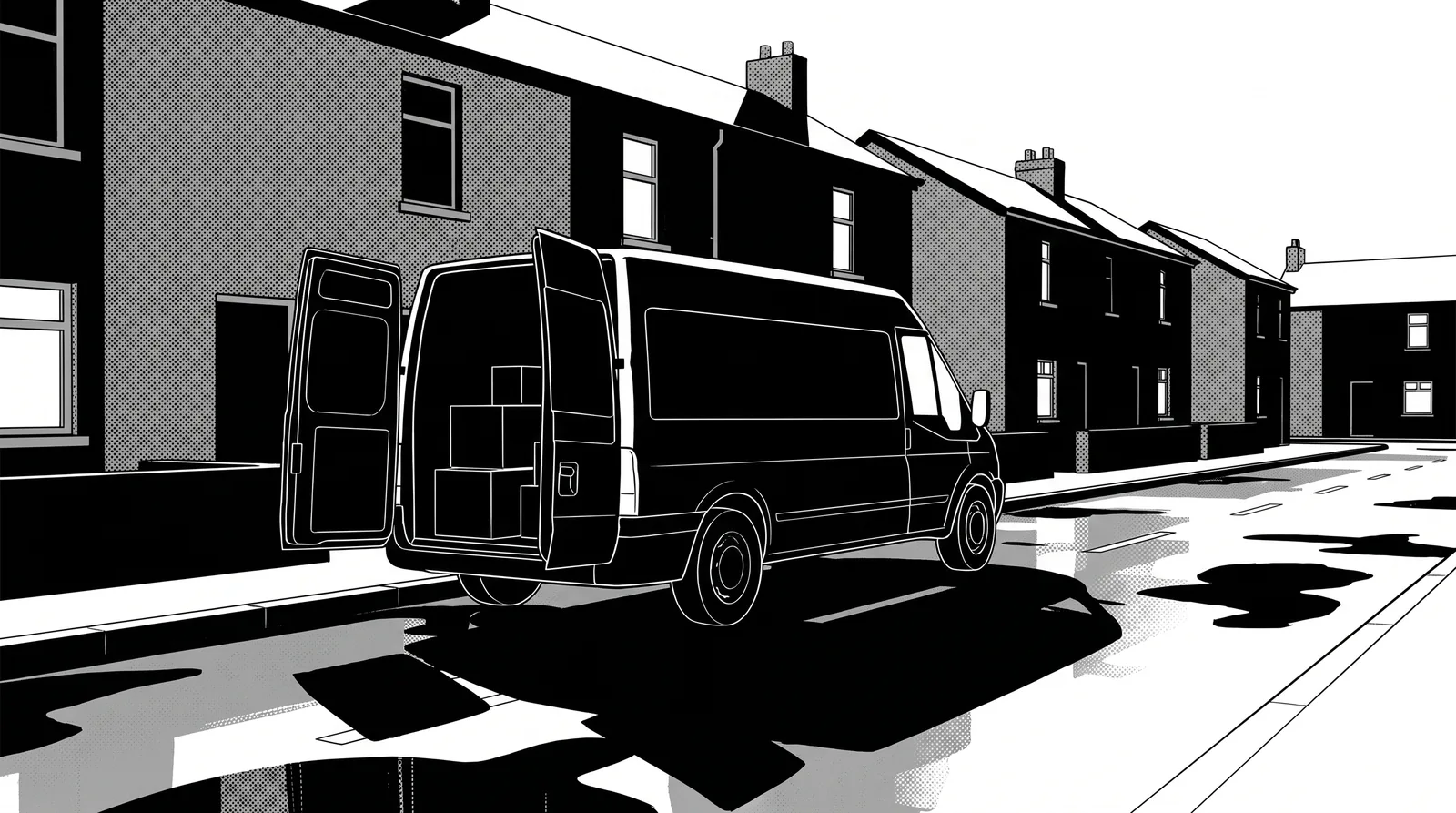
Half past seven on his own street, and a van being loaded opposite. The same six sentences pass every weekday between a man walking to the station and the man loading it: how he is, the rain, whether the van is heavy, something said to the dog in the front of it. Two years of that, and he could not give the other man’s name.
Two men make a noise at each other at the kerb and one of them drives off. It’s automatic.
The companion’s text names what goes on at the kerb: a supplement Malinowski wrote for a book about meaning. He calls it ‘phatic communion’, and defines it as ‘a type of speech in which ties of union are created by a mere exchange of words’ (p. 315). His own instances sit close to the van: ‘Inquiries about health, comments on weather, affirmations of some supremely obvious state of things’ (p. 313).
He does not say the words are empty. ‘Once again we may say that language does not function here as a means of transmission of thought’ (p. 315), and the ‘here’ restricts it to this use. In its place, ‘the situation in all such cases is created by the exchange of words’ (p. 315). The man supplies the taking of turns himself, before he is told whose observation it is: ‘the reciprocity is established by the change of roles’ (p. 315), and the pleasure is unequal, speaking being enjoyed more than listening (pp. 314–315). At the end of the supplement he looks back in his own first person: ‘we conceived human speech as a mode of action, rather than as a countersign of thought’ (p. 326).
The companion asks for the order of the six sentences, which the text supports: he supplies the forms and describes their sequencing (pp. 313–315). The answer it then rules out of place, a true account of how the man is, goes beyond them.
The supplement describes a use of speech in which nothing is carried and something is made all the same. The man has one morning when he asked it for something else.
Left open
Who do we say the same few things to, year after year, and still look for?
How long does something have to go on before it is part of our life?