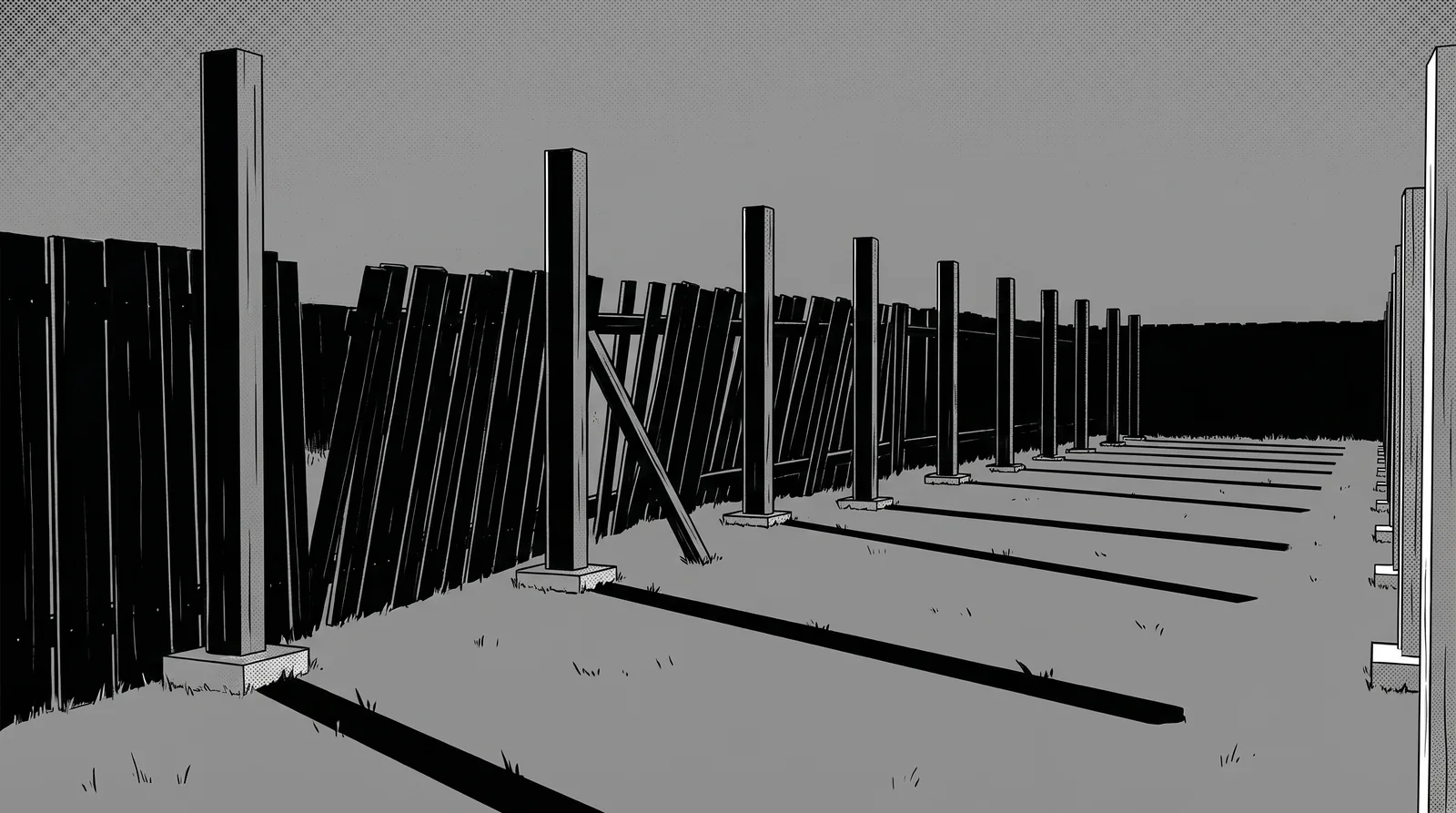
The posts went in last week, six foot of them in fresh concrete where the old fence came up to a man’s chest. The panels come on Friday, and until twelve that day the yard will swap the order for shorter ones with a foot of trellis on top. Next door has a greenhouse.
G. E. M. Anscombe’s Intention, published in 1957 and quoted here from the second edition of 1963, picks out intentional actions by a certain sense of the question ‘Why?’: the sense in which the answer, if positive, gives a reason for acting (§5, p. 9). One answer refuses the question application, ‘I was not aware I was doing that’ (§6, p. 11), and it is not open to a man who watched the greenhouse go up.
A single action can have many different descriptions (§6, pp. 11–12): sawing a plank, sawing oak, making a squeaky noise with the saw, making a great deal of sawdust. It can be intentional under one description and unintentional under another (§20, p. 30).
Her own case is a man pumping water into the cistern that supplies a house, who has been told the source is poisoned (§23, p. 37). Ask him why, and his answers run from moving his arm to poisoning the inhabitants (p. 40). Four actions, or only one? One, she answers, with four descriptions, ‘each dependent on wider circumstances, and each related to the next as description of means to end’ (§26, p. 46), the last swallowing up the ones before. It is his answer to ‘Why?’ that brings the series out (p. 45).
For a known effect a man does not aim at, she has another category: something is voluntary though not intentional, she writes, if it is ‘the antecedently known concomitant result of one’s intentional action, so that one could have prevented it if one would have given up the action’ (§49, p. 89). Of her pumper she says that the interest of his intention is certainly not an ethical or legal interest: if what he said was true, that will not absolve him (§25, p. 45).
None of which tells a man what he owes a neighbour for a shadow he did not set out to cast.
Left open
What does wanting to be left alone cost the people nearest to us?
How much of a life is made of what we allowed, rather than what we chose?