spiegamelo.com

Session 07 2 October 2026 10 min

Attention

On Sunday a friend of mine asked me out for a walk along the river, and told me something on the way, and I haven’t got a sentence of it.

Listen on Apple Podcasts Spotify Amazon Music iHeart Podcast Index

Plateas far as the bridge
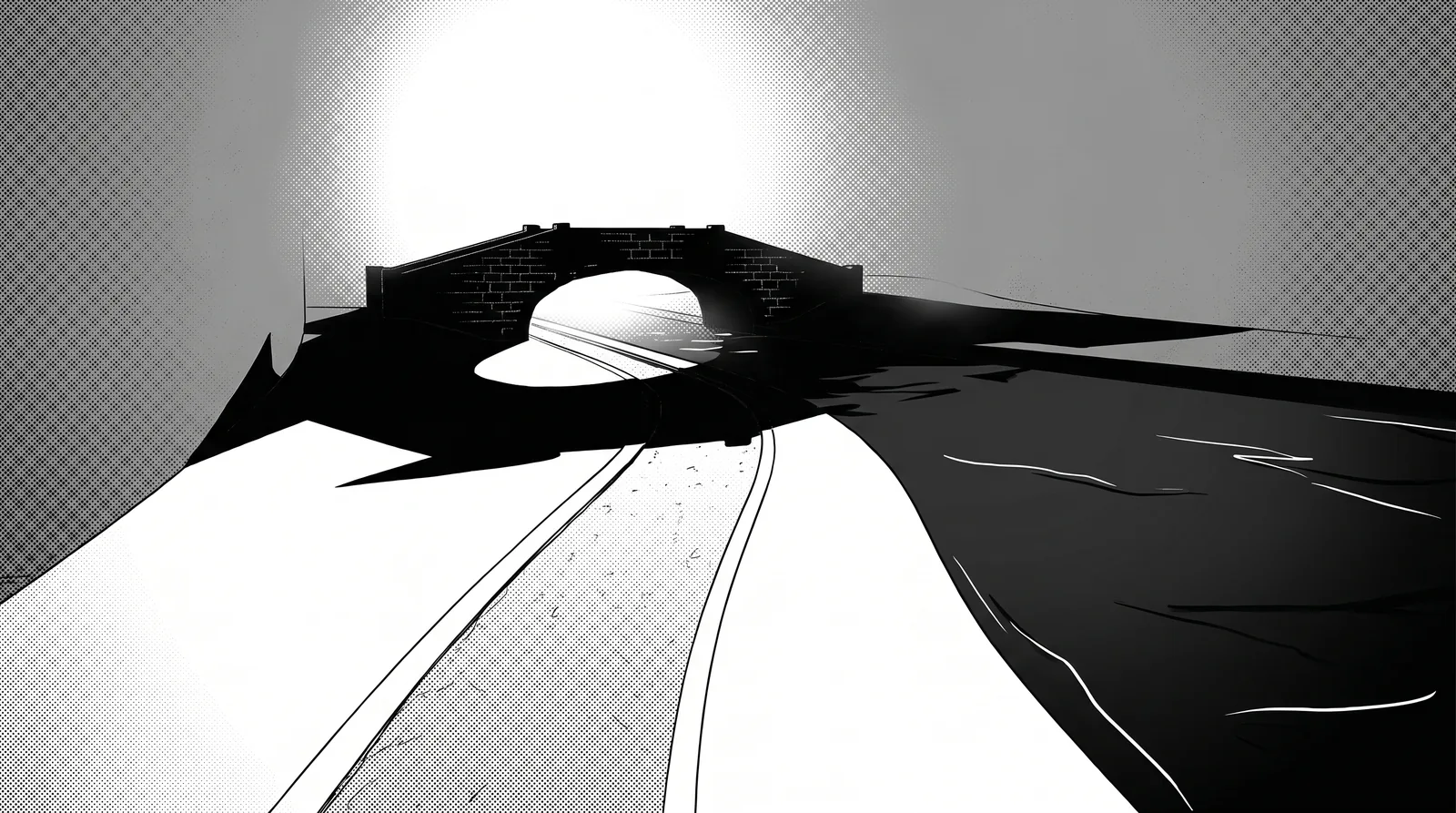
A river towpath seen low from the path itself, in high-contrast black and white. Pale wet gravel curves away into the distance beside flat, near-black water marked with a few thin white lines. A low brick footbridge stands small in the middle distance, dark against a bright hazy sky, its arch holding a patch of white light. Everything but the path and the sky sinks towards black, and nobody is in the picture.

Story

A man reads the same paragraph four times and reaches the end of it each time with nothing. What it brings back is Sunday: a friend who wanted to walk by the river with him, and told him something as they went, of which he cannot produce a line.

Simone Weil’s ‘Reflections on the Right Use of School Studies with a View to the Love of God’ is about schoolwork. Prayer consists of attention, she says, and school exercises train the attention that prayer is made of. The theology is not detachable: faith is the indispensable condition, and the fruit she promises in prayer is found only by believing first, or at least behaving as though one did. She allows, apart from that, something narrower: an effort of attention made with the sole idea of increasing one’s grasp of truth brings a greater aptitude for it, quite apart from explicit religious belief.

Attention, she says, ‘is an effort, the greatest of all efforts perhaps, but it is a negative effort. Of itself, it does not involve tiredness.’ Her target is the teeth-clenching kind of effort, which she gives almost no place in study. ‘Attention consists of suspending our thought, leaving it detached, empty and ready to be penetrated by the object.’

Weil makes the step to people herself: of those in affliction, ‘warmth of heart, impulsiveness, pity are not enough’. Going quiet is no simpler an answer. Takie Lebra, writing on silence in Japanese communication out of her own observation in Japan and America, distinguishes four dimensions of it and regards them as mutually contradictory, while declining to argue that Japanese silence is unique or to read universals into the Japanese case.

Weil has a use for the exercise that has gone wrong. It is to be contemplated attentively and slowly, ‘without seeking any excuse’ and ‘trying to get down to the origin of each fault’, since ‘there is no better exercise than such a tracing down of our faults’. One condition travels with it: the failed exercise is examined without overlooking any mistake or any of our tutor’s corrections.

Left open

What do we owe someone whose words we did not keep?

Who have we been quiet with, and did the quiet mean the same to both of us?
Sources

  1. Simone Weil, ‘Reflections on the Right Use of School Studies with a View to the Love of God’, trans. Emma Craufurd, in Waiting for God (New York: G. P. Putnam’s Sons, 1951; in Britain Waiting on God, London: Routledge and Kegan Paul, 1951); in French, ‘Réflexions sur le bon usage des études scolaires en vue de l’Amour de Dieu’, in Attente de Dieu (Paris: La Colombe, 1950), pp. 113–123: prayer as consisting of attention, and schoolwork as its training, French p. 114; faith as the indispensable condition, and the fruit in prayer found only by believing first or behaving as though one did, French p. 115; the effort made with the sole idea of increasing one’s grasp of truth, and the greater aptitude it brings, quite apart from explicit religious belief, French p. 116; contemplating the failed exercise attentively and slowly, without seeking any excuse, trying to get down to the origin of each fault, and overlooking no mistake and none of the tutor’s corrections, French p. 117; teeth-clenching effort as her target, and its small place in study, French p. 118; the negative effort, the tiredness it does not of itself involve, and attention as the suspending of thought, French p. 119; there being no better exercise than the tracing down of our faults, French p. 120; warmth of heart, impulsiveness and pity not being enough, where she comes to people in affliction, French p. 122. The English is Craufurd’s wording; no page of a printed English edition was seen.
  2. The six-page teaching transcription of the Fontana 1959 text of Craufurd’s translation, against which every English string quoted above was checked.
  3. Takie Sugiyama Lebra, ‘The Cultural Significance of Silence in Japanese Communication’, Multilingua 6(4) (1987), pp. 343–358, reprinted as chapter 10 of Identity, Gender, and Status in Japan: Collected Papers of Takie Lebra (Folkestone: Global Oriental, 2007), pp. 115–126: her observation in Japanese and American situations of social interaction, reprint p. 115; the four dimensions of silence she regards as culturally salient and mutually contradictory, and her declining to assert the uniqueness of Japanese silence or to read universals into the Japanese case, reprint p. 116.

The voices are synthesised. The incidents are invented. The problems are not, and the philosophy is quoted accurately or not at all.